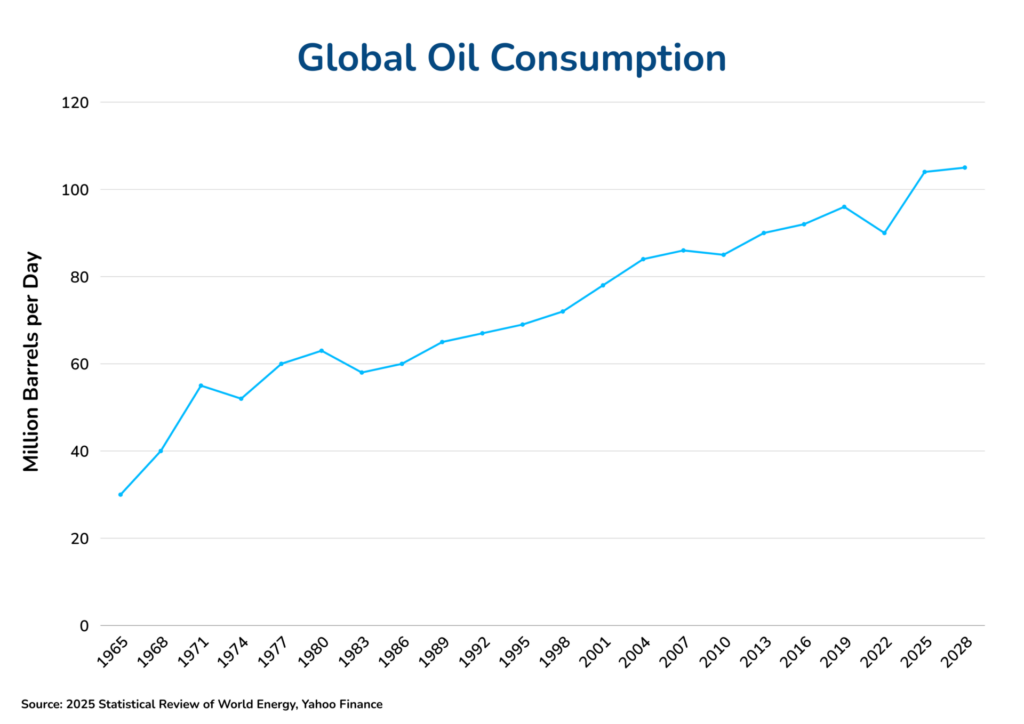
Research suggests that global oil demand could peak at around 105 million barrels a day in 2028, before beginning to fall over the following decades, with demand gradually dropping to roughly 84 million barrels per day by 2060 – levels not seen since 2005.
Global demand is already hovering around 104 million barrels a day, so a projected peak of roughly 105 million in 2028 is less a dramatic surge and more a sign that growth may be flattening before a longer, more meaningful decline sets in.
Peak Oil Now Means Peak Demand
The phrase “peak oil” is often used in different ways. In older debates it referred to supply limits, but many current forecasts focus on peak demand. That is the point at which total oil consumption reaches its highest level and stops growing year on year.
This direction is consistent with other major outlooks. The International Energy Agency (IEA) has indicated that global oil demand growth is expected to slow significantly by 2028, with demand reaching around 105.7 million barrels per day by that point under current conditions. The common theme is that the period of steady demand growth may be ending.
Why Demand Could Still Rise Before It Falls
A near-term peak does not mean oil demand drops immediately. Some uses of oil are difficult to replace quickly, especially in parts of industry and international transport. Aviation and petrochemicals are often expected to hold up for longer than road fuels, with jet fuel consumption projected to increase by around 50% as air travel demand expands significantly. Natural gas liquids used in petrochemicals, plastics and manufacturing are expected to take a larger share of total oil demand, rising to around 30% by 2060.
At the same time, the areas where alternatives are already available are changing faster. Electrification of road transport, improvements in fuel efficiency, and tighter emissions regulation all reduce the growth rate of petrol and diesel demand over time, with global gasoline demand thought to drop by two thirds by 2060. As these changes scale, they can offset growth elsewhere and lead to a peak in total demand even if some sectors remain reliant on oil.
Why Moving Away From Oil Remains Important
Even if global demand peaks around 2028, oil would still be used at scale for many years. A peak is not the same as a rapid decline, and a slow reduction in demand can still result in high emissions over time. Oil combustion remains a significant source of greenhouse gas emissions, so reducing reliance on oil is central to meeting climate targets and lowering long-term climate risk.
There is also a resilience case. Oil markets can be volatile, and price changes can feed into wider costs such as transport, production, and inflation. Reducing exposure to oil where alternatives are viable can improve cost control and reduce vulnerability to external shocks.
The Role of Renewables and Electrification
The main route to reducing oil demand is to increase clean electricity and use it more widely. Renewables are already expanding in many markets, and as power generation becomes cleaner, electrification becomes more effective as a decarbonisation option across transport and parts of industry. Electric vehicles are a clear example, but electrification also includes heat pumps, electric process heat in some industrial settings, and wider efficiency measures that reduce fuel demand overall.
The IEA’s view that demand growth will slow by 2028 is linked to these wider shifts, including faster deployment of clean energy technologies and structural changes in energy consumption. For organisations, this reinforces the need to connect decarbonisation plans to practical actions, including electrification options, renewable procurement, and energy efficiency improvements.
If oil demand peaks near 105 million barrels a day in 2028, the shift will not be immediate, but it will affect decision-making now. The direction of travel is becoming clearer, and organisations that plan early are more likely to manage cost and compliance pressures effectively as the transition develops.