
Recent research has highlighted a significant issue within the UK energy market: around 14 million households are currently with energy suppliers with below-average customer service ratings. This finding, based on Citizens Advice’s latest Star Rating system, raises important questions about service quality, consumer experience and the wider functioning of the energy market.
Understanding the Ratings System
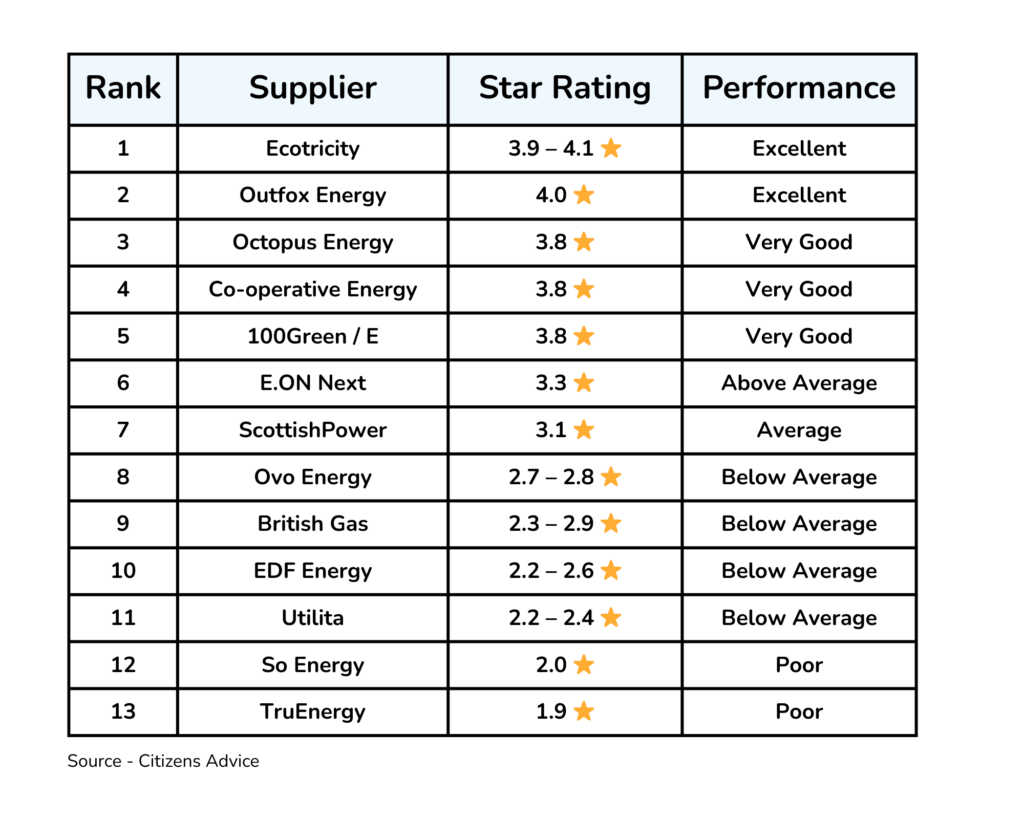
The Citizens Advice Star Rating evaluates suppliers on several key factors, including billing accuracy, complaint handling, customer support accessibility and overall service standards. Current data suggests that roughly half of UK energy customers are with suppliers that score fewer than three out of five stars.
While the overall average sits slightly above this level, the distribution indicates that a substantial proportion of households are not receiving consistently high-quality service.
This is not a new concern, but the scale is notable. Customer service in the energy sector has been under scrutiny for several years, particularly following supplier failures, rising energy costs and increased demand for support during periods of financial pressure.
How the “Big Six” Compare
When looking specifically at the UK’s largest energy suppliers, often referred to as the “big six”, the picture is mixed but generally falls below the top-performing providers. E.ON Next and ScottishPower sit closer to the middle of the table, delivering broadly average service level.
Ovo Energy and British Gas tend to score lower, with more variability in customer experience depending on the metric being measured. EDF Energy also sits toward the lower end of the rankings. Overall, none of the largest suppliers feature among the highest-rated providers, which suggests that scale and market share do not necessarily translate into stronger customer service performance.
What Poor Service Looks Like in Practice
For consumers, below-average service can take a number of forms. These may include delayed responses to queries, difficulty contacting suppliers, billing inaccuracies or challenges resolving complaints. While these issues may appear operational, they can have a tangible impact on households, particularly when combined with financial pressures linked to energy costs.
Access to timely and effective support is especially important for vulnerable customers. Those using prepayment meters or those already struggling to manage bills may be disproportionately affected by service shortcomings, making the quality of supplier support a critical factor rather than a secondary consideration.
Variation Across the Market
It’s important to recognise that supplier performance is not consistent across the sector. Some providers have achieved strong ratings, demonstrating that high levels of customer service are achievable within the current market conditions. Others, including some well-established suppliers, continue to perform below average.
This variation highlights a key dynamic within the energy market. While competition exists, it does not always result in uniformly improved customer outcomes. Although switching suppliers is an option for many households, the process can be influenced by tariff structures, perceived risks and a lack of clear, comparable information. As a result, a significant number of customers remain with underperforming suppliers.
Wider Pressures on the Energy Market
The issue of service quality cannot be considered in isolation. The broader energy landscape remains complex, with ongoing external pressures such as global price volatility continuing to affect both suppliers and consumers. These conditions can place additional strain on customer service operations, particularly during periods of increased demand.
At the same time, rising costs and economic uncertainty increase the need for clear communication and reliable support. In this context, customer service becomes an essential component of how effectively households can manage their energy usage and associated costs.
The Role of Regulation and Transparency
Regulatory bodies such as Ofgem play a central role in maintaining standards across the energy market. Initiatives that promote transparency, including the publication of supplier performance ratings, are designed to provide consumers with clearer information and encourage improvements across the sector.
However, the continued presence of below-average ratings for a large proportion of households suggests that transparency alone may not be sufficient to drive widespread change. Ongoing regulatory oversight and industry engagement are likely to remain key factors in addressing these challenges.
The finding that 14 million households are with poorly rated energy suppliers underlines an ongoing issue within the UK energy sector. While there are clear examples of good practice, the overall picture indicates that service quality remains inconsistent.
As the energy sector continues to evolve, particularly in response to economic pressures and the transition to more sustainable systems, maintaining a strong focus on customer service will be essential.