The rapid expansion of digital services is reshaping energy demand at a pace few anticipated. Data centres are growing in number and scale, AI workloads are accelerating across industries, and electricity consumption is rising sharply as a result. With that growth comes a practical decarbonisation problem: these facilities need power 24/7, and unless that electricity is consistently low-carbon, emissions rise in step with demand.
This is why low-carbon generation such as nuclear is back in the conversation — not as a replacement for renewables, but as a potential way to supply always-on electricity at scale while supporting emissions reduction.
The Rising Environmental Impact of Data Centre Water Use
The environmental impact of AI-driven data centres is not limited to electricity consumption — it also extends significantly into water use, with consequences for local ecosystems, communities and carbon emissions. AI’s water demand could reach billions of cubic metres annually, posing a substantial threat to water security both globally and within the UK.
This challenge compounds existing pressures, with the UK already forecast to face a daily water deficit of nearly 5 billion litres by 2050 due to climate change, population growth and infrastructure limitations — a deficit that additional data centre demand could amplify.
Data centres consume water in several ways: directly for server cooling (e.g. evaporative cooling systems), indirectly via water used in electricity generation, and further upstream through processes such as semiconductor manufacturing. For example, large hyperscale facilities can use around 2 million litres of water per day, and a 100 MW data centre may consume up to 2.5 billion litres annually — roughly equivalent to the annual water needs of 80,000 people.
Why Data Centres Create a Different Kind of Demand
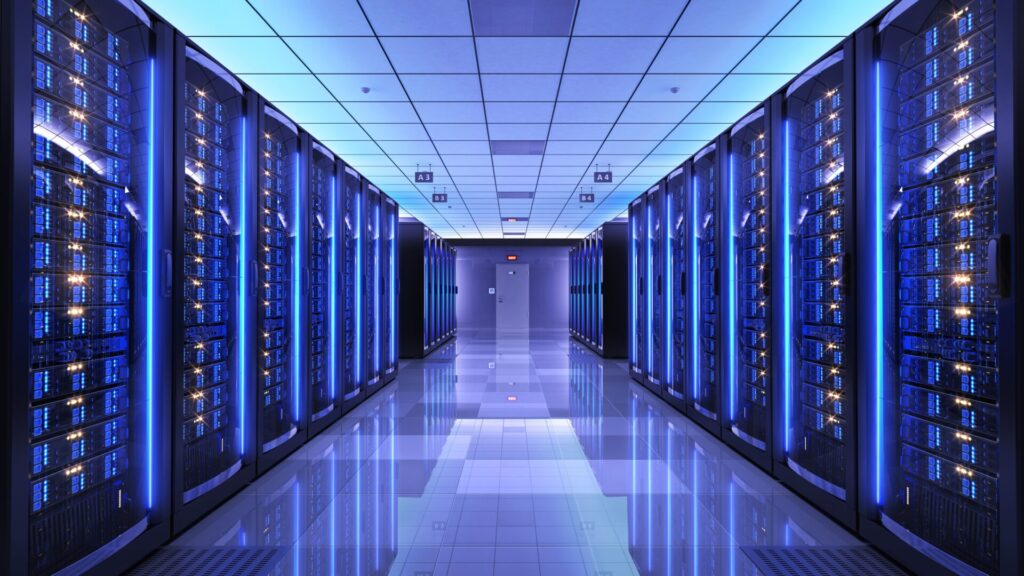
Data centres are unlike many other large electricity users. They are designed for continuous operation, with downtime measured in seconds rather than hours. Even as operators improve efficiency through better cooling, server optimisation and workload management, total electricity demand continues to rise because compute intensity is increasing.
AI is a major driver of this trend. Training large models and running real-time inference both require significant energy input, often concentrated over long periods. This creates sustained demand that does not easily flex around weather patterns or peak and off-peak pricing. As a result, the growth of data centres places pressure not only on generation capacity but also on networks, connection queues and system resilience.
The Appeal of Nuclear as Firm Low-Carbon Power
Nuclear energy’s central advantage is its ability to provide stable, high-capacity electricity with very low operational emissions. For constant loads such as data centres, this firmness can reduce reliance on fossil-fuelled backup generation and help lower carbon intensity on an hour-by-hour basis rather than just over the course of a year.
This has renewed interest in advanced nuclear technologies. Small Modular Reactors (SMRs), in particular, are often highlighted as a potential alternative to traditional large-scale nuclear plants. The promise lies in modular construction, shorter build times and greater flexibility around siting. In theory, these features could make nuclear better suited to meeting demand growth linked to digital infrastructure.
That said, much depends on delivery. Cost certainty, construction timelines and regulatory approval will ultimately determine whether these technologies can scale fast enough to make a material difference.
Growing Interest, but Not a Short-Term Solution
Nuclear’s re-emergence is not limited to policy discussions. The data centre sector’s growing demand for dependable low-carbon power is pushing a broader reconsideration of how “clean” electricity is sourced, and whether future supply will be sufficient in the right places at the right times. At the same time, the constraints are significant.
Nuclear projects can involve long development timelines, complex licensing and planning processes and substantial capital requirements. Even with modular approaches, widespread deployment will take years rather than months. In the near term, network constraints and connection delays are likely to remain more immediate barriers to meeting demand than generation availability alone.
Nuclear Alongside Renewables, Storage and Grid Investment
The most realistic role for nuclear is as part of a broader, integrated energy mix. Wind and solar will continue to deliver large volumes of low-carbon electricity and are often the fastest and cheapest options to deploy. Storage technologies are improving, and demand-side flexibility can help smooth some of the peaks created by digital workloads.
In this context, nuclear can provide firm capacity that supports the system during periods of low renewable output. A blended approach reduces exposure to price volatility, supports system resilience and improves the credibility of emissions reductions by aligning consumption more closely with real-time generation. For data centres, this combination can help balance sustainability objectives with operational requirements, particularly as scrutiny increases around the difference between contractual claims and actual grid impact.
As digital infrastructure continues to expand, energy systems will need to adapt quickly. New nuclear power is re-entering the conversation as a potential source of firm, low-carbon electricity for data centres. The most robust path forward is likely to combine nuclear, where feasible, with rapid renewable deployment, storage, grid upgrades and smarter demand management.